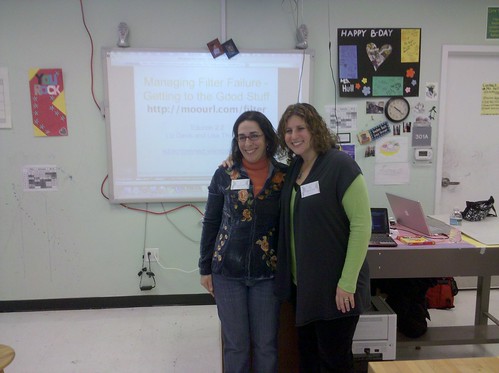
This blog post is a follow-up to Liz and Lisa's awesome workshop at Educon 2.2 (January 31, 2010).
This should be no surprise to anyone who knows me even remotely: I like social media and I like to try new shiny toys on the internet. I try to spread the joy as much as possible about my discoveries, because I'm a Sniff (that's a "Who Moved My Cheese" reference)...
But every now and then, I hear this:

Created by Online Education
And then, think of it this way: If you get cable or satellite television at home, you probably have access to roughly 150 channels of continuous programming. This means that if you wanted to watch all programs on all channels (excluding reruns), you would need 150 hours every hour.
The point here is that you have millions and millions of information channels competing for your attention, but, as a normal human being, you can only tune in to one channel at a time.
So I guess everybody else is right, and there's no sense in even trying to absorb it all! Even if you would spend all your days reading and learning, at the end of your life, you will have been exposed to only a grain of rice in the universe of knowledge, and you would be falling behind even more at every instant.
At the heart of my social media strategy is social bookmarking. Social bookmarking is probably the activity that I do that has the most value to me, and projects the most accurately my professional persona. Below is a diagram of my discovery and sharing workflow.
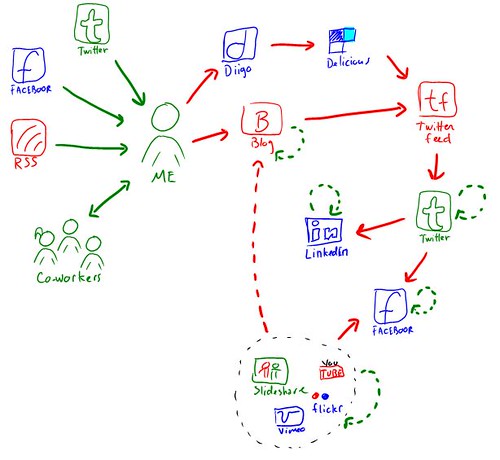
I have created a chain of events that happen every time I find something relevant on the internet. Everything that at the left of me is what I call my "Personal Awareness Network" (that's the new term I just coined to refer to what I consciously expose myself to by subscribing to it). Whenever something finds me and catches my attention, I start reading it, determine if this is something I need to read in detail, try to find a paragraph in the text that summarizes the content and highlight it, click the Diigo bookmark button in my browser toolbar, enter the relevant tags, and hit save. This simple action triggers everything on the right side.
Am I cheating my followers on Twitter, Facebook, and LinkedIn? Not really, since they have decided to pay attention to my stuff. They opted-in to my social stream, the same way I have opted-in to the stream of others. Anyone annoyed with my behavior is allowed, no, hold on, INVITED to unfriend/unfollow me. That includes Facebook, yes. Don't make your life miserable because of me.
I don't really read everything I bookmark, I get myself exposed to it and save it for future reference. If your labeling strategy is efficient, you should be able to retrieve a lot of the articles you have been exposed to using this technique, even as your list grows bigger and bigger (I have almost 3,000 bookmarks in Diigo - try fitting that in your browser's favorites just for fun).
Now, I read to make myself aware of stuff. I am not afraid to forget details, since details are a couple of keystrokes away, stored in my personal knowledge base, safely backed-up and available on the web, away from my potentially virus-infested PC.
I believe my mind is like a sponge. Once it gets full, it drips. The smaller chunks (information and data) drip away, and the bigger chunks (wisdom, experiences, knowledge) form patterns and clusters of assumptions, attitudes, and values that can guide my behavior when faced with familiar and new situations in life.
This should be no surprise to anyone who knows me even remotely: I like social media and I like to try new shiny toys on the internet. I try to spread the joy as much as possible about my discoveries, because I'm a Sniff (that's a "Who Moved My Cheese" reference)...
But every now and then, I hear this:
- I don't know how you do this, you must not have kids I suppose...(I don't)
- There is just too much information, I can't follow all of this...
- My e-mail is already out of control, and now you want me to use what?
How Big is the Problem Anyway?
Do we really understand how big the internet is... This clever infographic demonstrates the scale of the damage.
Created by Online Education
And then, think of it this way: If you get cable or satellite television at home, you probably have access to roughly 150 channels of continuous programming. This means that if you wanted to watch all programs on all channels (excluding reruns), you would need 150 hours every hour.
The point here is that you have millions and millions of information channels competing for your attention, but, as a normal human being, you can only tune in to one channel at a time.
So I guess everybody else is right, and there's no sense in even trying to absorb it all! Even if you would spend all your days reading and learning, at the end of your life, you will have been exposed to only a grain of rice in the universe of knowledge, and you would be falling behind even more at every instant.
My Social Media Inventory
Beyond just letting go, there must be a middle ground to try to get exposed to the right information. A couple of months ago, I decided to create an inventory of my social media tools and strategies. Although it might look like a lot, all of these tools are just a part of my routine now.
At the heart of my social media strategy is social bookmarking. Social bookmarking is probably the activity that I do that has the most value to me, and projects the most accurately my professional persona. Below is a diagram of my discovery and sharing workflow.
I have created a chain of events that happen every time I find something relevant on the internet. Everything that at the left of me is what I call my "Personal Awareness Network" (that's the new term I just coined to refer to what I consciously expose myself to by subscribing to it). Whenever something finds me and catches my attention, I start reading it, determine if this is something I need to read in detail, try to find a paragraph in the text that summarizes the content and highlight it, click the Diigo bookmark button in my browser toolbar, enter the relevant tags, and hit save. This simple action triggers everything on the right side.
Am I cheating my followers on Twitter, Facebook, and LinkedIn? Not really, since they have decided to pay attention to my stuff. They opted-in to my social stream, the same way I have opted-in to the stream of others. Anyone annoyed with my behavior is allowed, no, hold on, INVITED to unfriend/unfollow me. That includes Facebook, yes. Don't make your life miserable because of me.
I don't really read everything I bookmark, I get myself exposed to it and save it for future reference. If your labeling strategy is efficient, you should be able to retrieve a lot of the articles you have been exposed to using this technique, even as your list grows bigger and bigger (I have almost 3,000 bookmarks in Diigo - try fitting that in your browser's favorites just for fun).
My Learning Style
All of this thinking about my use of social media got me reflecting on how I learn. I am not the type of person who remembers everything word for word. I use to hate reading for the longest time because the only time I read when I was young was when I had to study for an exam. I always feared that I would forget something, so I read, highlighted, and re-read everything to be able to regurgitate enough information on my exams to get a good grade.Now, I read to make myself aware of stuff. I am not afraid to forget details, since details are a couple of keystrokes away, stored in my personal knowledge base, safely backed-up and available on the web, away from my potentially virus-infested PC.
I believe my mind is like a sponge. Once it gets full, it drips. The smaller chunks (information and data) drip away, and the bigger chunks (wisdom, experiences, knowledge) form patterns and clusters of assumptions, attitudes, and values that can guide my behavior when faced with familiar and new situations in life.
Remembering everything is plain utopia. The cloud does it better than you, so don't fight it.
Even if I'm a thousand articles behind on my Google Reader, I don't panic. I read whatever catches my attention, and go with the flow. At some point, I mark everything as read and move on. If something is important enough, it will find me again, because I have set my personal awareness network that way. I'm doing my best in making my grain of rice as pertinent as possible for my own professional development needs.
Technology only does a part of the filtering. This whole opt-in strategy is fine to do the first rough pass, but your real filter is in your head. Any learning is good learning. My advice: Don't let the hugeness and absurdity of the universe of information prevent you from at least trying.
Filters can also be people. As you learn new stuff, you can always bounce off the information with a colleague you trust to get their view on it. That is something Liz explained about her relationship with Lisa during conferences, and I think that's a pretty decent practice.
And then ask yourself: Would you follow yourself? With the quantity of web artifacts you leave online, can you expect anyone to pay attention to every little detail? You also have to be a filter for your colleagues.
Selecting Your Channels
As Chris Anderson exposes it in Free, when it comes to information, I embrace waste. If I stumble upon an interesting blog post or article, I usually look for the profile of the writer and look for the RSS orange button to add the feed to my Google Reader. If the blogger hit a home run on the article I have read and doesn't follow-through with new good ones, I simply unsubscribe. I also always try to follow them on Twitter, look at the people they have conversations with, follow them, etc.
Even if I'm a thousand articles behind on my Google Reader, I don't panic. I read whatever catches my attention, and go with the flow. At some point, I mark everything as read and move on. If something is important enough, it will find me again, because I have set my personal awareness network that way. I'm doing my best in making my grain of rice as pertinent as possible for my own professional development needs.
Technology only does a part of the filtering. This whole opt-in strategy is fine to do the first rough pass, but your real filter is in your head. Any learning is good learning. My advice: Don't let the hugeness and absurdity of the universe of information prevent you from at least trying.
Filters can also be people. As you learn new stuff, you can always bounce off the information with a colleague you trust to get their view on it. That is something Liz explained about her relationship with Lisa during conferences, and I think that's a pretty decent practice.
And What About the Outbound Information?
So far, I have only exposed how I manage inbound information. That's great, because I can develop my own self, but what about my colleagues and friends? I find stuff daily that my colleagues should be interested in, yet I don't share everything with them. This is a tricky and sensitive subject, and here's why: opting-in is a personal choice. This means that I can't push too much information to my colleagues, I have to respect their choice. They might have other ways of developing their skills, and nagging by sending them links every day will not help them feel compelled to establish their own personal awareness network.
And then ask yourself: Would you follow yourself? With the quantity of web artifacts you leave online, can you expect anyone to pay attention to every little detail? You also have to be a filter for your colleagues.
One strategy is to accumulate resources just-in-case someone asks for it (I grabbed that one from Beth, who I did not know before and happened to be sitting right next to me). If you know that your boss will someday be interested in [insert topic here], then start tagging your links with his/her name, or a tag that is unique and makes sense. When the time comes and that he/she pops the question, send a link to the stuff you have tagged for that occasion. That will make you look smart ;-)
----
So, what's your strategy to manage filter failure? Please share your ideas and experiences by commenting to this post!